
en.wikipedia.org/wiki/Euonymus_americanus
I have recently learned as I become a proper scientist that scientific writing is the andote to emotional bosh writing, which is my preferred style. Improvisation and poetry is why I love to write, but alas not why we should be writers. Takeaway the brutality and curiosity schism behind E. Hemingway the creator, extract from the mess the diamonds, feed it light.
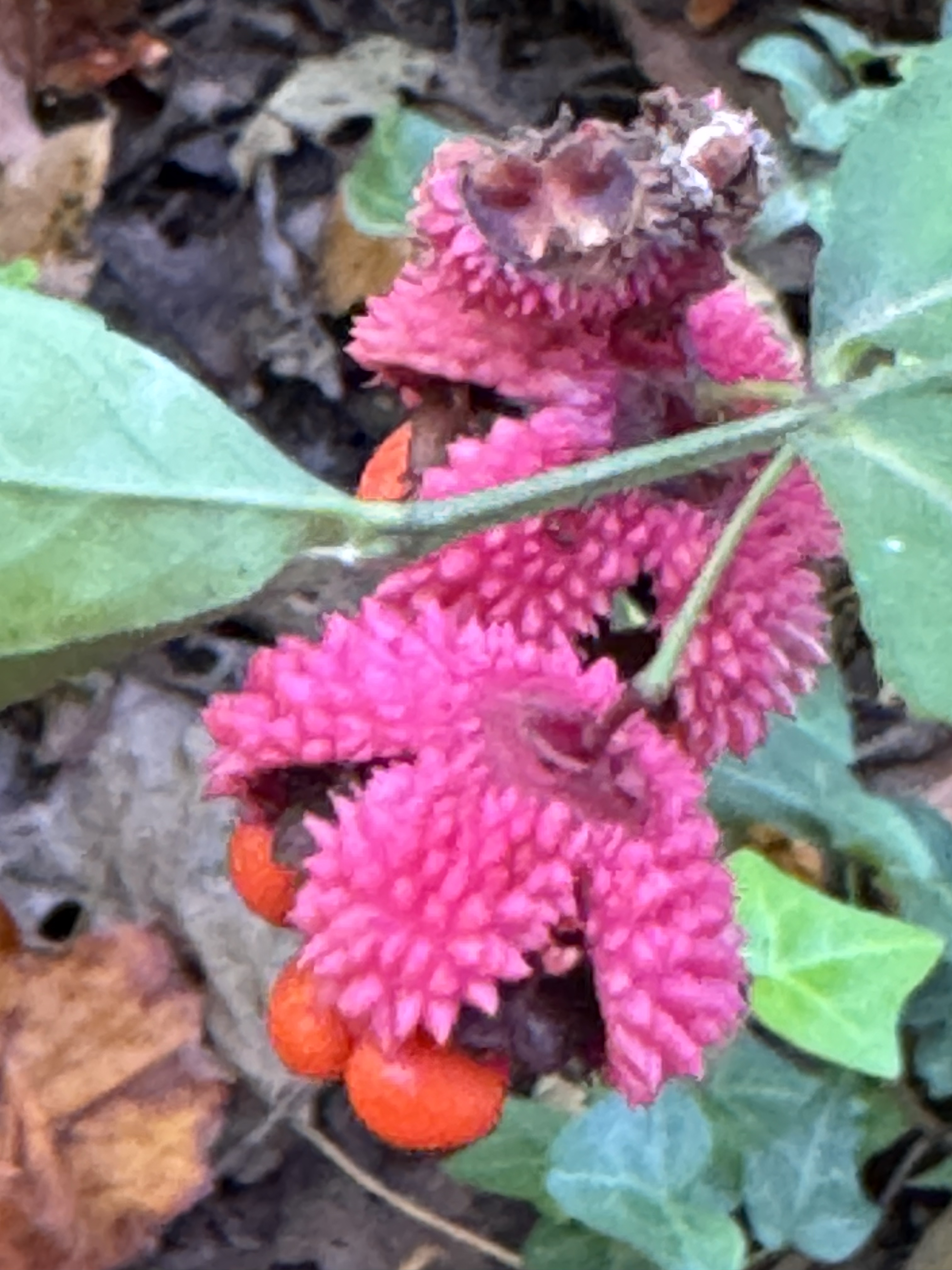
The strawberry bush (Euonymus americanus) blossoms. If your lucky you see them across the field, and they pull you in like unexpected bone. Of course being a greedy man I want to immediately consume it or whip out my phone toy and snap an image up. Now I must pause for Wikipedia to educate us further:
https://en.wikipedia.org/wiki/Euonymus_americanus?wprov=sfti1#Traditional_uses
Recall that there was a time before Wikipedia. What’s the difference between a Wiki an AI. Time, software, and hardware. Nature operates the same way though, well back that up. If we read the popular scientific story about E. americanus, the biology God bless it, we learn that this vivid flower belongs to a species that thrives in the moist shade, marshes and river banks, which like Wikipedia and someday AI are here today but gone tomorrow. Not E. americanus mind you, the ecological system where it exists today.
What are you talking about TEH, or as my polite students say: “maybe if you rephrase the question”. Let’s tack this way. Strawberry bush is the common name, because most Americans know what a strawberry looks like and tastes like. We being humans know strawberry phenotypes or features of one domesticated plant which botanists capitalize on to help us understand this new species of plant. Thus they dangle adjectives and our brain recognizes the pattern.
However, here’s the rub (which I can say because this is my blog), there are actually many processes underlying this process at play when cataloging phenotypes and common characteristics. One is the mapping various species with language because our brains like patterns, another is evolution through Darwinian Natural Selection which of course lengthens this post considerably as I do plan to do soon.
Until then though just know it gets interesting very fast. First we must not get distracted by interesting correlations prematurely, for example my fields and forest where my ruminants and wild ruminants graze are filled with wood strawberries (Fragaria vesca) but this is the first strawberry bush (Euonymus americanus) blossom I have seen.
Additionally, investigate:
- Southeastern U.S.A, James W. Hardin, Small bog of cypress an dmixed hardwoods, (7 Apr 1955) Euonymus americanus L. Retrieved from the Digital Public Library of America, http://n2t.net/ark:/65665/337744452-6f6c-4e0d-9d14-e2bb267a9317
- Howard, G. T., & Elliott, L. P. (1988). Effects of cellulolytic ruminal bacteria and of cell extracts on germination of Euonymus americanus L. seeds. Applied and Environmental Microbiology, 54(1), 218–224. https://doi.org/10.1128/AEM.54.1.218-224.1988
- Wyatt, R., Beliveau, B. D., & Wyatt, G. E. (2023). Reproductive biology of Euonymus americanus (Celastraceae): Pollination by ants and cockroaches. The Journal of the Torrey Botanical Society, 150(4), 538. https://doi.org/10.3159/TORREY-D-21-00005
- Thrift, John, “Effects of White-tailed Deer Herbivory on Forest Plant Communities” (2007). All Theses. 155.
https://open.clemson.edu/all_theses/155